Who Has the Final Say? Understanding the Legal Authority for Funeral Arrangements in California
Who Has the Final Say? Understanding the Legal Authority for Funeral Arrangements in California
The time immediately following the loss of a loved one is emotionally devastating, and the last thing anyone wants is a painful family dispute. Unfortunately, disagreements over final wishes—like burial versus cremation, or the type of service—are common. In California, the question of who has the legal right to control the disposition of remains and make funeral arrangements is not left to chance or general family agreement; it is strictly and clearly defined by California Health & Safety Code (HSC) Section 7100.
This statute establishes a detailed and rigid priority list. Understanding this hierarchy is the single most important step you can take to ensure your own wishes are honored, or to navigate the funeral process for a family member with clarity and authority.
The Legal Hierarchy: A Step-by-Step Guide
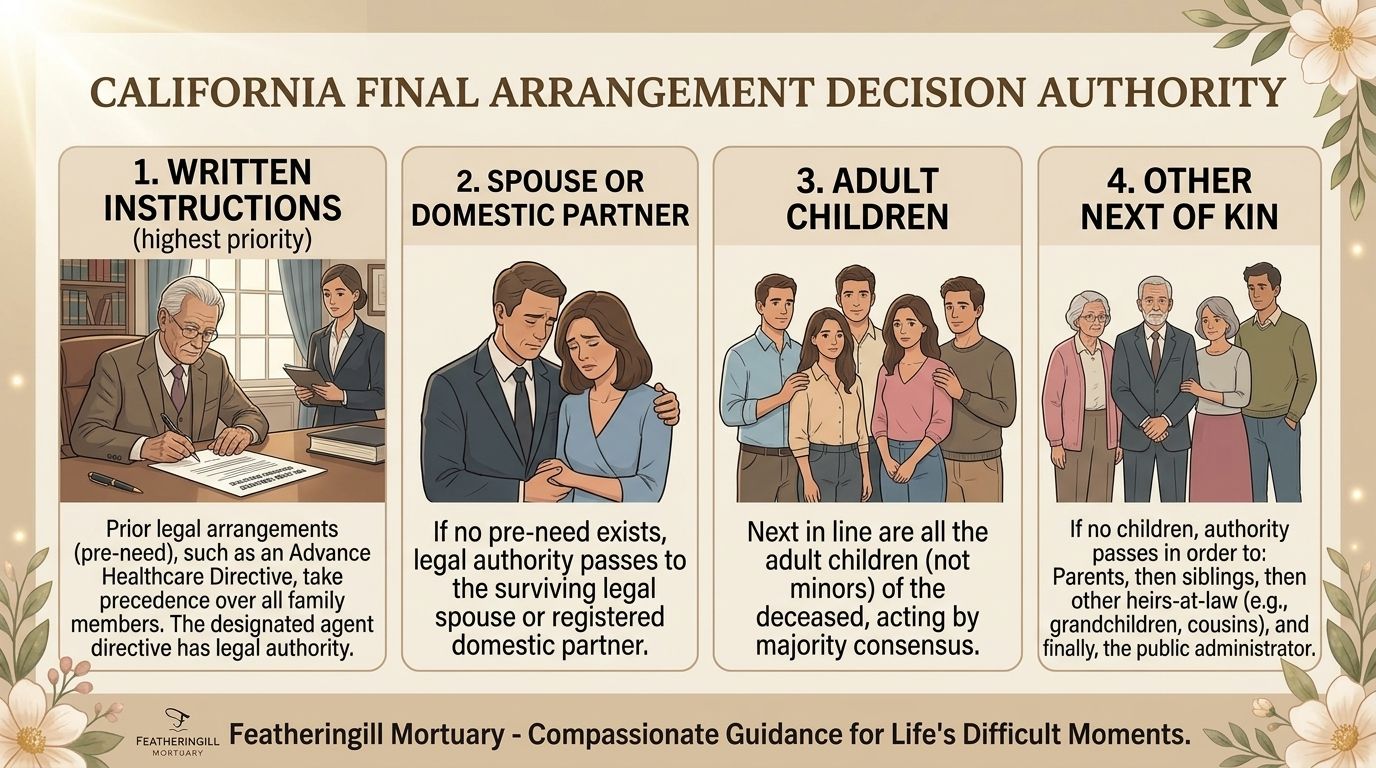
The authority to make final decisions rests exclusively with the highest-ranking individual or group on the following list. If a person in a higher category exists and is competent, the authority does not pass to the next category.
1. The Decedent’s Written Instructions (HSC § 7100.1)
Your own clear, written directions for disposition and funeral services take first priority—but with a crucial caveat. To be legally binding and unalterable, the written instructions must:
- Clearly and completely set forth the final wishes in sufficient detail to preclude any material ambiguity.
- Include arrangements for payment through trusts, insurance, or other binding means to cover the costs, thereby precluding the survivor(s) from having to pay.
If payment arrangements are not made, your remaining wishes will only be carried out to the extent your estate has sufficient assets. This demonstrates that expressing your wishes isn't enough; securing the funding for them is equally vital for legally binding control.
2. Agent under a Power of Attorney for Health Care
If the deceased executed an Advanced Health Care Directive, the agent named within that document has the next right of disposition, provided the directive specifically grants this authority. This is a common and highly effective way to name a trusted, non-family member who will prioritize your wishes above all else.
3. Surviving Spouse or Registered Domestic Partner
If there are no valid written instructions or a named agent with disposition rights, the authority falls next to the competent surviving spouse or registered domestic partner. This equal priority is established by California Family Code §297.5, which grants Registered Domestic Partners the same rights as spouses under state law. Many people mistakenly believe this is the starting point of the legal process.
4. Adult Children
Next in line are the adult children. The right of control belongs to the sole surviving competent adult child, or the majority of surviving competent adult children if there is more than one.
5. Parents
If there are no qualifying adult children, the authority passes to the surviving competent parent or parents. If only one parent is competent and available after reasonable effort to locate the other, that parent holds the right.
6. Adult Siblings
Following the parents are the adult siblings. As with the children, the right belongs to the sole surviving competent adult sibling, or the majority of surviving competent adult siblings.
7. Next of Kin
The hierarchy then extends to the majority of surviving competent adults in the next degree of kinship (e.g., grandparents, grandchildren, aunts/uncles).
8. Conservator or Public Administrator
Finally, if no family member in the above categories exists or is competent, the authority may pass to a court-appointed conservator or the Public Administrator, provided the decedent's estate has sufficient assets to cover the costs.
The Importance of Advance Planning
The strictness of HSC 7100 is designed to prevent drawn-out legal battles and provide funeral homes and cemeteries with a clear line of authority, allowing for timely disposition. However, it also highlights the critical need for proactive estate planning.
- Avoid Family Conflict: Imagine a scenario with multiple adult children who disagree vehemently on cremation versus burial. If the deceased left no valid instructions, the majority rules, potentially causing a deep rift. A clear, funded document removes this decision from the hands of grieving family members.
- Ensure Your Wishes are Honored: If you desire an unconventional disposition (such as a green burial or specific religious rites) or wish to exclude an estranged family member who is legally high on the list, your written instructions are the only guarantee. Without them, a spouse or adult child could legally override your verbal requests.
- Overriding the Default: The California code ensures that the person you trust to execute your wishes can do so by naming them as your Health Care Agent with the right of disposition. This person does not have to be a family member and can leapfrog over the spouse or children in the statutory list.
In the end, while the law provides a safety net, it's a net of last resort. Taking the time to execute a legally sound document that both outlines your wishes and secures payment is the most loving, responsible act you can perform for those you leave behind. It replaces uncertainty and potential strife with clarity and peace.